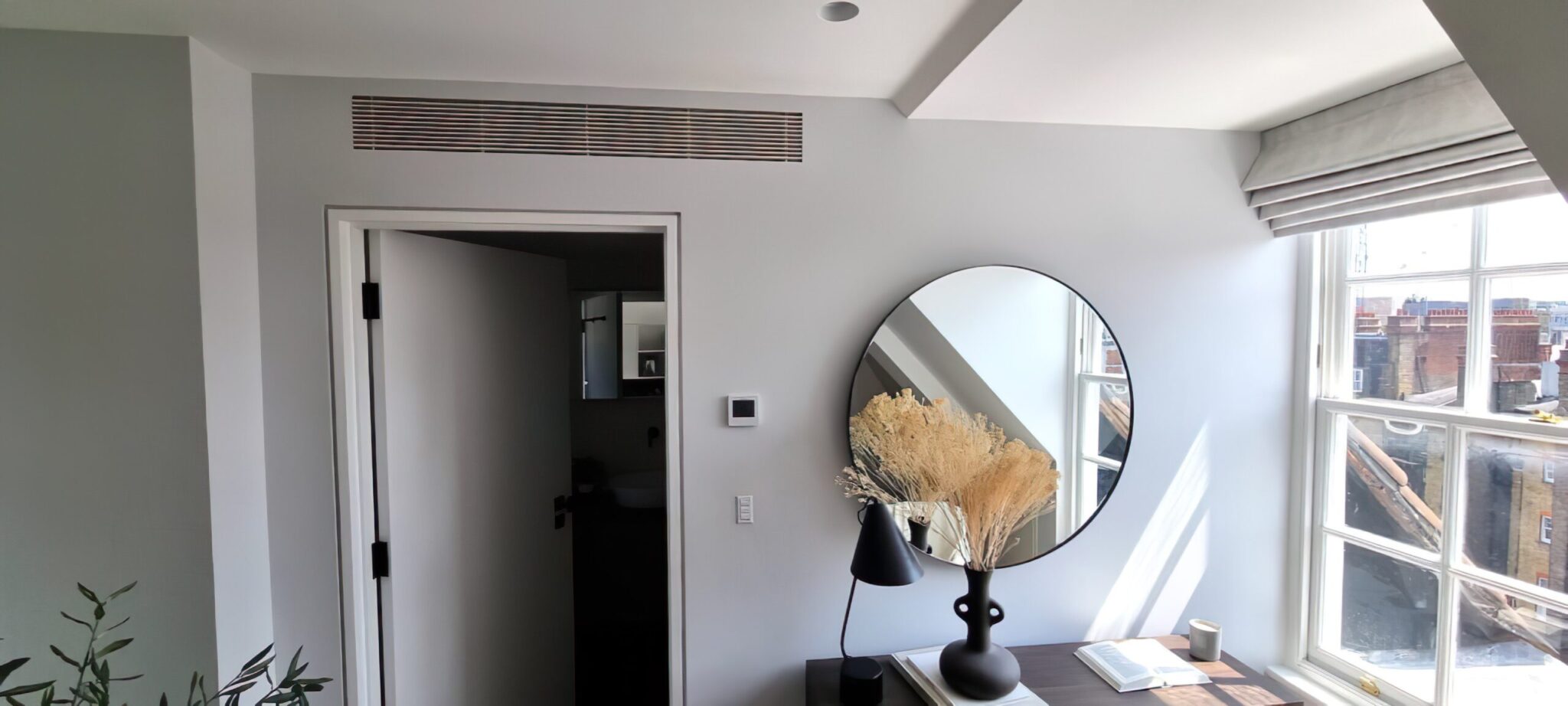
A home office, loft conversion or garden room can be one of the hardest parts of a home to keep comfortable. A loft may lose heat through its roof in winter and become too warm in summer. A garden room may be separate from the home’s central heating. And an office used for only part of the day needs to warm up quickly without running unnecessarily.
The best heating system depends on the room’s construction, how often you use it and whether it overheats in warmer weather. For some spaces, extending the existing central heating is straightforward. For others, an air conditioning system that also provides heating can offer a practical year-round solution. Here are the main options to consider.
Why are these rooms harder to heat?
Loft conversions sit directly below the roof, so their temperature can respond quickly to changing weather. Garden rooms are exposed on more sides than a room within the main house, and they may not be connected to the boiler. A home office can have similar issues if it is in an extension, above a garage or rarely used outside working hours.
Insulation, draught-proofing, window size and orientation all affect comfort. Consider summer as well as winter: a room that is pleasant on a cold morning may become uncomfortable on a sunny afternoon.
What heating systems can you choose from?
Extending central heating
If your loft conversion is part of the main house, adding a radiator to the existing central heating may be a suitable option. A heating engineer can check whether the boiler and pipework have enough capacity for the additional radiator and whether the system needs adjusting. This can work well where the boiler is in good condition and the room does not have a separate cooling problem.
The main limitation is that a radiator only heats the space. If your loft becomes too hot in summer, you will need a separate way to cool it. Pipework may also involve changes to finished walls or floors.
Portable and fixed electric heaters
Plug-in heaters and fixed electric panel heaters are simple to install and can be useful in a room that is occupied occasionally. They do not need to be connected to a boiler, which can make them an easy starting point for a small garden room or workspace.
However, direct electric heaters convert electricity into heat at the point of use. They can be expensive to run for long periods, especially in a room used every working day. Poor insulation and draughts can make the room harder to heat.
Electric underfloor heating
Electric underfloor heating provides warmth across the floor and leaves the walls free for furniture. It is often considered during a new build or refurbishment. Retrofitting it can require lifting or replacing flooring, so it may be disruptive in an established room.
Like other direct electric heaters, it uses electricity to generate heat. It can provide comfortable background warmth, but it does not cool the room during summer. It is important to choose a system suited to the floor construction and follow the manufacturer’s guidance on insulation and controls.
Air conditioning with heating
Many modern air conditioning systems are air-to-air heat pumps. In heating mode, the system transfers heat from the outside air into the room. In cooling mode, it moves heat out of the room. This means one installation can provide both heating and cooling, without connecting to the home’s wet central heating system.
Because a heat pump moves heat rather than generating all of it directly from electricity, it can provide more heat energy than the electricity it uses. Actual performance depends on the model, outdoor conditions and installation. Correct sizing and sensible temperature settings matter.
An air-to-air system heats the air in the room; it does not provide hot water or heat radiators elsewhere in the home. The indoor unit is commonly wall-mounted, although concealed and ducted options may suit some layouts. AAC can explain which arrangement may work for your space as part of a domestic air conditioning installation.
How do the running costs compare?
Running costs depend on your electricity tariff, the room’s heat loss, the weather and the temperature you set. Direct electric heaters provide one unit of heat for each unit of electricity used. A heat pump can deliver several units of heat for each unit of electricity, although the amount varies in real-world use.
As an illustration, using an electricity rate of 26.32p per kWh, a direct electric heater would cost around 26.3p for each kWh of heat produced. If an air-to-air heat pump provides three units of heat per unit of electricity, the equivalent cost would be about 8.8p per kWh of heat. This is a simple comparison, not a quote or a guarantee of savings; the rate is based on the Ofgem price cap for October to December 2026 and may not match your tariff. Your actual costs will also depend on the system and the way you use it.
For more detail on the factors that affect a system’s price and use, read AAC’s guide to air conditioning installation and running costs.
Which heating system suits each room?
A home office inside the house
If the room already has a radiator and stays comfortable throughout the year, you may not need another heating system. If it is difficult to cool in summer, or if you want to control its temperature separately from the rest of the house, an air conditioning unit with a heating function may be worth considering. See AAC’s advice on cooling your home office.
A loft conversion
Extending central heating can be practical if the boiler has sufficient capacity and the pipework can be installed without major disruption. If the loft also overheats in summer, an air conditioning system can address both seasonal issues. AAC explains the options in more detail in its article on air conditioning in a loft conversion.
A garden room
For occasional use, a portable electric heater may be enough, particularly if the room is well insulated. For a garden office or gym used regularly, a fixed system that heats and cools can help make the space more useful throughout the year. Learn more about air conditioning for a garden room.
What should you check before installing a system?
Consider how well the room is insulated, its size and windows, and when you will use it. Decide whether you need quick heating, background warmth, summer cooling or all three. The outdoor unit location, electrical supply and pipework route can also affect the design.
Planning rules for outdoor units depend on the property and the installation. In England, air conditioning equipment with a heating function may fall under permitted development in some circumstances, but limits and conditions apply. Listed buildings, conservation areas and local restrictions can change what is allowed, so check with your local planning authority before work begins.
Find the right heating system for your home
There is no single best heating system for every home office, loft conversion or garden room. A radiator may be a good fit where central heating is already available and summer temperatures are not a concern. Electric heaters can suit occasional use. For a room that needs regular heating and becomes uncomfortable in warm weather, air conditioning with a heat pump function may provide a flexible alternative.
AAC has installed air conditioning in homes across North London and Hertfordshire since 1999. The team can assess the space, discuss how you use it and recommend a system sized for the room. To talk through your options, visit the domestic installation service, use the online booking form or review AAC’s finance options.
FAQs
Is air conditioning cheaper to run than an electric heater?
It can be, because an air-to-air heat pump moves heat from outside rather than producing all the heat directly from electricity. The saving depends on the system, room insulation, weather, tariff and settings.
Can I extend central heating into a loft conversion?
Often, yes. A heating engineer should check whether the boiler and pipework can support an additional radiator and confirm what changes are needed.
What is the best heating system for a garden room used all year?
For a well-insulated room used regularly, an air-to-air heat pump can provide heating in winter and cooling in summer. A simple electric heater may be enough for occasional use.
Do I need planning permission for home air conditioning?
Some domestic systems with a heating function may be permitted development in England, subject to conditions and restrictions. Listed buildings, conservation areas and local planning rules need particular care, so check before installation.
Is electric underfloor heating cheaper to run than an electric radiator?
For the same heat output, direct electric heating uses electricity in a similar way. Underfloor heating may feel different because it spreads warmth across the floor, but it does not automatically use less energy.
Can air conditioning heat a loft conversion in winter?
Yes. Many modern air conditioning units are reversible heat pumps and can provide warm air in winter. A survey can help determine the right system size and indoor unit position for the room.

